'There have been rumours circulating for some time, never proven,
that IWD was supplying the defoliant Agent Orange to be used in the
Vietnam War. The allegation is true. I was on the management committee
of Ivon Watkins Dow, and I supported the plan to export Agent Orange. In
fact, it went ahead on my casting vote.
'People who'd served in the armed forces made a strong case for the
need to defoliate the jungle, because of the risk to servicemen from
ambush or sniper fire from the undergrowth.
"So we began manufacturing this Agent Orange, but it didn't meet
the international specifications and probably had an excess of 'nastes'
in it. The problem was, we didn't consider the product was harmful to
humans at the time.
"Our scientists relied on assurances and technical data provided to
them by Dow Chemicals in the USA. We were led to believe it was safe.
The whole reason I supported Agent Orange is because we thought we were
giving our boys on the ground a hand.
"To avoid detection, we shipped the Agent Orange to South America -
Mexico if I recall correctly - and it was on shipped to its final
destination from there."
The former IWD boss' confessions will come as a bombshell - not
just to the company which for more than 30 years has managed to avoid
admitting to it, but also to the credibility of the last Labour
Government, which arranged a Parliamentary Select Committee Inquiry in
1990 into the matter.
|
|
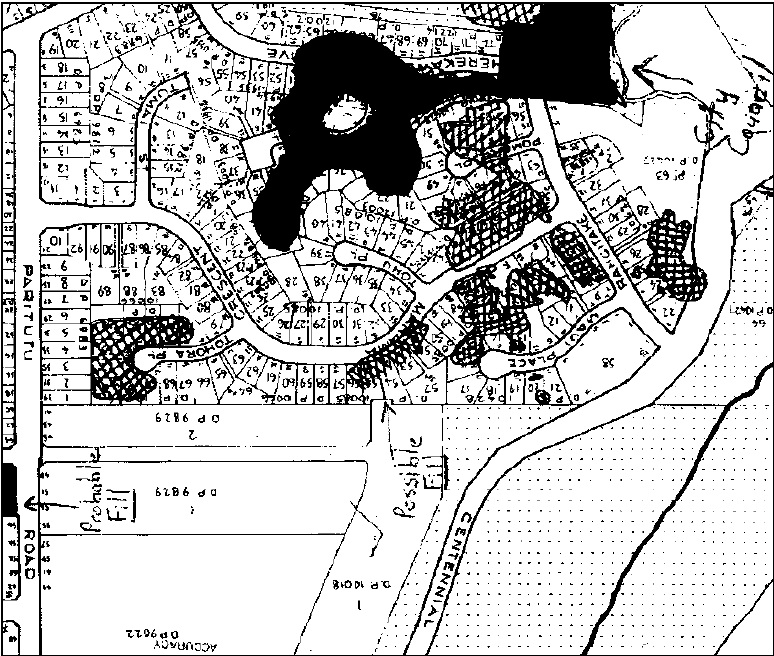
Part of New Plymouth's district plan for the area in 1977, to be compared with the 1967 photo on the opposite page.
The Chemical Factory's grid testing area - seen clearly in the picture opposite - begins in the blank Space in the
lower left corner of the district plan, and the factory itself extends beyond the lower border of the image.
Areas of black fill or hatched filled on the image correspond to areas residents suspect are contaminated |
That Inquiry's findings were that "No conclusive facts or evidence
were provided to the Committee to substantiate the claim that IWD
manufactured the formation of Agent Orange in New Zealand during the
Vietnam War."
At the time, the Select Committee's terms of reference were
attacked as being too narrow, and the Labour dominated committee did not
call any former executives of Ivon Watkins Dow to give evidence. It is
now easy to see why.
'Agent Orange was made from two chemicals," our source explained in
an exclusive interview, "2,4-D and 2,4,5,T. When they're apart, they're
herbicides. Mixed together, they become Agent Orange. Now at this time,
in the late 1960s and early seventies, the Government had given IWD the
exclusive licence to manufacture those chemicals. We made all of the
2,4-D and 2,4,5-T that was produced in New Zealand. No one else was
allowed to. Technically, we shipped the chemicals unmixed, so
technically they weren't Agent Orange until somebody mixed them at the
final destination."
IWD's role in manufacturing the deadly herbicide resulted from a US
approach to the New Zealand Government, and the Defence Ministry had
sounded out whether IWD could provide 500,000 gallons of it, quickly.
Although news of the plan later leaked out, the National Government
tried to distance itself and the impression was left that the Agent
Orange deal never went ahead.
|
|
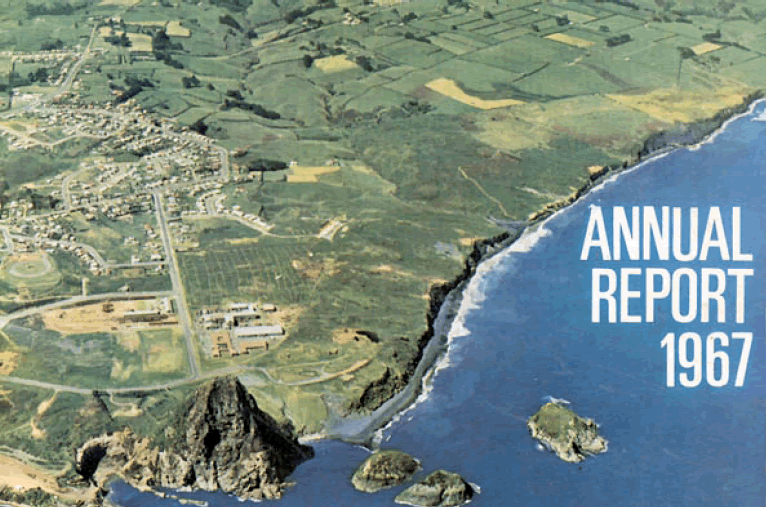
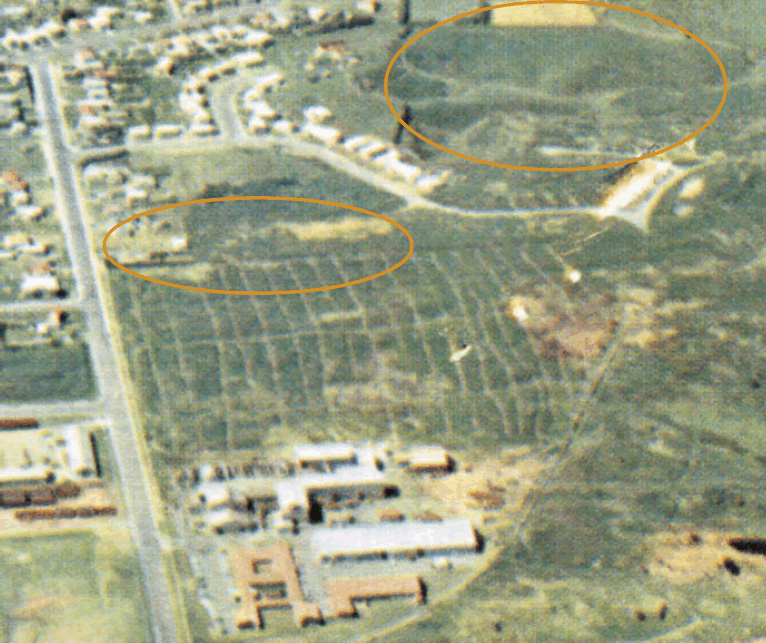
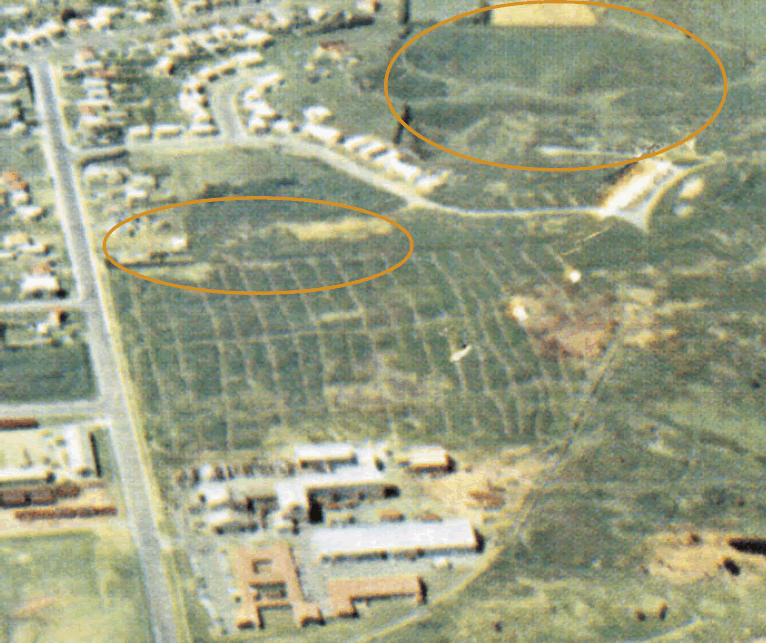
The IWD plant in 1967. Much of the pasture towards the middle and
top of the picture was used for housing in the 1970's. The smaller
circle shows an area subsequently built on where home owners saw "foamy
liquid" bubbling from the ground, but were told "not to worry" by IWD.
The larger circle is an area subsequently filled in for housing
purposes, now suspected to contain Agent Orange and where residents have
dug up 44 gallon drums of chemicals in their gardens. Areas of the
ground discolouration may indicate the presence of chemicals |
Given that official US reports record that around 9 million gallons
of Agent Orange were dumped on Vietnam, the size of the NZ contract was
reasonably substantial.
The official's evidence is likely to open the way for New Zealand
Vietnam Veterans to sue both Dow Agrosciences, which now operates the
IWD plant, and the New Zealand Government for compensation. Vietnam
veterans and their families have, in many cases, suffered major health
problems and birth defects as a result of alleged exposure to Agent
Orange in Vietnam, but up until now there's been no proof that IWD was
definitely involved.
The revelations get worse, however. The official says leftover
Agent Orange chemicals, complete with 'excess nasties" were re-worked
into the 2,4,5-T herbicide for use on farms within New Zealand, and
surplus chemicals were dumped at the Experimental Farm, which is now
believed to lie underneath the New Plymouth suburb of Paritutu.
Which may explain why the suburb has the highest levels of the
deadly chemical dioxin - an ingredient of Agent Orange - ever recorded
in a New Zealand urban area, according to a Ministry for the Environment
report in 1998.
If the official's testimony is correct, it is highly likely that
leach-ate from 2,4-D and 2,4,5-T dumped in the ground would eventually
mix - assuming they hadn't been tossed in to the same pit together
already - creating a lethal Agent Orange mix under the soil.
|
|
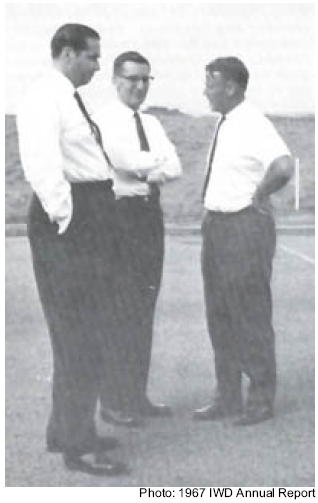
L to R: Earle Barnes, DOW USA director
of corporate manufacturing Herbert Doan
, DOW USA President and Dan Watkins,
IWD managing director. Doan and Barnes
certainly knew how deadly their chemicals
were. Watkins probably knew |
"I remember at one meeting,' says the former IWD top executive,
'that there was some real concern expressed about the chemical dump. 'If
it leaches down onto the beach, we're going to be in real trouble',"
one IWD scientist had warned. The dumping operation was described by our
source as "surreptitious".
And if any further proof were needed that surplus Agent Orange had
been dumped at New Plymouth, local residents found a drum of the
chemical on the beach near Waireka Stream.
But a local newspaper report in the mid-seventies sheds more light on the situation:
"Drums of chemical waste buried under lvon Watkins Dow Ltd's
proposed housing subdivision are not considered a hazard by its
management," the Taranaki Herald newspaper begins.
"The Managing Director, Mr R M Bellen, confirmed that drums of
waste had been buried in the land, but said none of the material was
dioxin and all was expected to degrade in the ground without any harmful
effects.
"They were also buried in a remote part of the proposed subdivision where they would not cause problems to development.
'The existence of the drums was brought to the public's attention
by a letter to the editor of the Herald, signed by 'Concerned'. He said
large quantities of drums containing chemicals were buried in trenches
over a period of years. Five years ago [1972] one of the Taranaki
newspapers ran a picture of the work in progress.
"By now the soil will be contaminated and the fitting of
underground services will further spread the chemicals,' he said.
'Dioxin and other unwanted chemicals are now destroyed in an
incinerator. About 12 years ago IWD dumped drums of chemicals in the
city dump. The chemical seeped into the Mangaetuku Stream and the city
council spent days collecting the dead eels and burying them."
The chemicals being dumped in 1972, after the US decided to stop
using Agent Orange in Vietnam, were highly likely to have been Agent
Orange or its ingredients. Having boosted production to meet the US
orders, IWD was left with tens of thousands of gallons of the deadly
poison.
And there's documentary evidence to support the claims by the
former IWD boss that Agent Orange, complete with some of the most lethal
toxins known to man, was reworked into ordinary farm herbicides for use
within New Zealand.
A 1987 Ministry of Agriculture report notes the use of a "scrub
dessicant" on our farms, made up in equal measure by combining 2,4,5-T
and 2,4-D. In other words: Agent Orange.
Our executive source's wife also recalls the 'hush hush" nature of
the Agent Orange programme: "My husband came home one night when all the
fuss was going on about Agent Orange, and I remember him saying to me
'We must never breathe a word of this to anyone. No one must ever find
out'." . . .
. . . Time, and a realisation that the chemical was more
deadly than he or his colleagues at IWD realised, have changed his
opinion. "It is time for the truth to emerge. Something needs to be
done," he says.
Investigate approached Health Minister Annette King who has so far
proved reluctant to dig into the matter, and asked if she would be
prepared to consider granting the former official immunity if he
testified at a Royal Commission of Inquiry into the matter. So far, the
Minister has failed to respond.
At stake for the government could be massive compensation payments:
these are the same herbicides used on most farms throughout New
Zealand, chemicals which may explain a sudden explosion in birth defects
and chronic illnesses in children and adults from the 1960s onward. The
cost in health bills to the country over the past 30 years may far
exceed what the Government spends on tobacco related illnesses or car
crashes, which may also explain the expensive TV advertising campaigns -
a distraction from the bigger issue.
The former IWD boss says he and his colleagues all had
shareholdings in the company, something he believes was an effective
means of buying silence and loyalty.
Among the documents provided by the official is a copy of IWD's
1967 Annual Report, which discloses that the company purchased 400 acres
of land to use for experimenting with herbicides and pesticides. This
included a 300 acre dairy farm stretching south from the main chemical
factory, a 90 acre "research farm" at Waireka Stream, and a 12 acre
research farm at Junction Rd in New Plymouth. This was in addition to
the 29 acres that the factory originally sat on in Paritutu.
'Possession of the new research station," wrote IWD Managing
Director Dan Watkins in his report to shareholders in 1967, "and the
developed area at Junction Rd, as well as the 300 acre Beach Road Dairy
Farm helps materially in keeping us close to all types of farming and to
all means of production from the soil. Thus we are able to evaluate
critically new methods of pasture and crop protection with insecticides
and weed control with herbicides, as well as means of raising production
by the use of fertilisers."
But while Prime Minister Helen Clark's colonial government
continues to duck for cover, it's been revealed dying Vietnam War
veterans are threatening to "do a Timothy McVeigh' - a reference to the
American anti-government protestor allegedly responsible for blowing up
the federal building in Oklahoma City several years ago.
Vietnam Veterans Association chief, John Moller, says . . .
. . . passions are running so high that he and his
colleagues have had to work "damned hard" recently to persuade dying
veterans whose children have also been affected by dioxin-related
deformities, "not to take the law into their own hands. These guys have
had enough. They're being cheated and lied to by the politicians and the
bureaucrats.'
US health authorities have recently added diabetes to the list of
diseases caused by dioxin, and Moller points out that the massive rate
of diabetes in the Maori community may be a direct result of exposure to
the 2,4-D and 2,4,5-T herbicides.
"Go back two or three decades and a lot of Maori people were
working outside, as farmhands, labourers, railway workers, soldiers,
forestry workers - all of them in areas where they came into contact
with chemicals containing dioxin."
And the point about dioxin is that it doesn't just affect the
person originally exposed, it affects their children through several
generations as well.
|
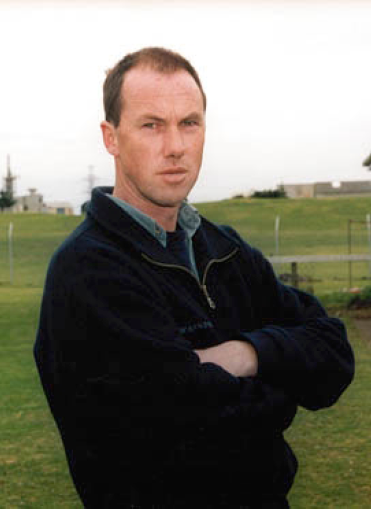
| Andrew Gibbs | |
There is evidence, still being collated by Investigate, of
politicians having financial links to chemical manufacturers in the
past, which may also be a factor in why successive governments have
either been reluctant to investigate, or they've set up dodgy, "Yes
Minister" type inquiries designed to prolong the cover-up.
Meanwhile, environmental campaigner and Paritutu resident Andrew
Gibbs, whose investigations brought the disaster to light, is
researching the involvement of Broadbank Corporation as the developer of
Paritutu subdivision, and whether it knew or should have known it was
building houses on a toxic dump. Broadbank was managed at the time by
Don Brash, the man who is now Governor of the Reserve Bank.
|
|
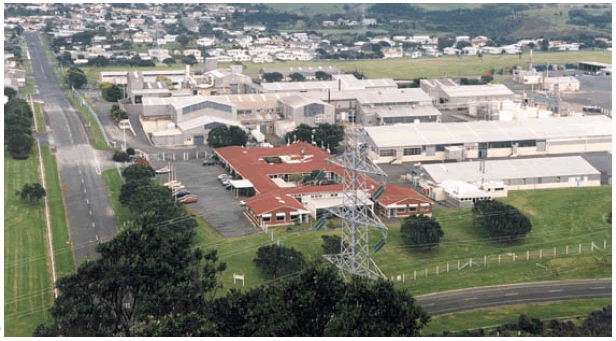
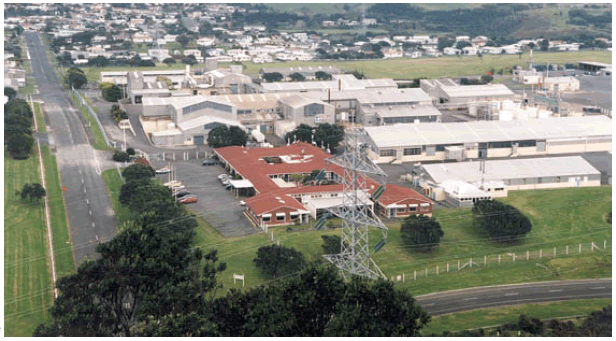
The Chemical plant as it is today. The Factory had been extended towards the town. |


.jpg)